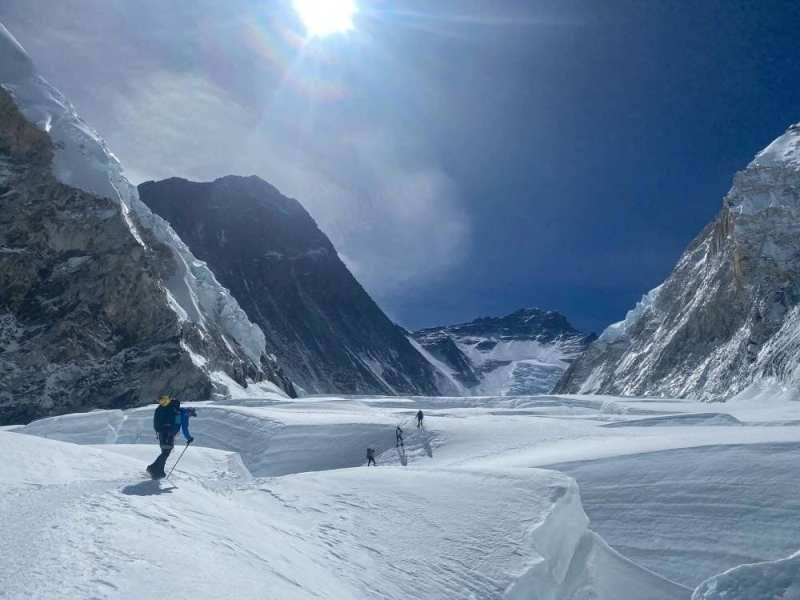
The summit of Mount Everest, at 8,848 meters above sea level, has long been a symbol of human ambition. For decades, climbers from around the world have sought to conquer its icy heights, pushing the boundaries of physical endurance and mental resilience. But in recent years, a group of Chinese climbers has redefined what it means to summit the highest peak on Earth—not by breaking records or using advanced technology, but by stripping away the trappings of modern mountaineering and embracing the essence of human determination.
In 2018, a team of eight Chinese climbers embarked on an expedition that would capture the world’s attention. They were not seeking to be the first, the fastest, or the youngest. Instead, they set out to climb Everest without the use of oxygen masks, a decision that would test their physical and mental limits in ways few others had dared to attempt. This was no mere feat of athleticism; it was a profound statement about resilience, equality, and the power of human spirit.
The climbers were not professionals, nor were they backed by corporate sponsorships or state-of-the-art equipment. They were ordinary people from different walks of life—teachers, factory workers, and office employees—who shared a common passion for the outdoors. Their journey began long before they set foot on Everest, with months of rigorous training to prepare their bodies and minds for the grueling ascent.
As they made their way up the mountain, they faced challenges that would have daunted even the most experienced climbers. The thin air at high altitudes left them gasping for breath, and the extreme cold tested their endurance at every step. Yet, despite these obstacles, the team pressed on, drawing strength from their shared determination and the knowledge that they were rewriting history.
Their decision to climb without oxygen masks was not arbitrary. It was a deliberate choice to challenge the conventions of mountaineering and to prove that success is not determined by external factors but by inner resolve. While many climbers rely on bottled oxygen to conquer Everest, this team chose to rely solely on their own bodies and willpower. Their ascent became a testament to the idea that true resilience lies not in what we use to achieve our goals but in how we rise above them.
The climbers’ journey was not without its controversies. Some criticized them for taking unnecessary risks, while others questioned whether such an approach could ever be sustainable. But as the team reached the summit and returned safely, their achievement became undeniable. They had not only scaled Everest but had done so in a way that redefined what it means to conquer the world’s highest peak.
For these climbers, their ascent was more than just a physical challenge; it was a statement about equality and inclusion. By choosing to climb as ordinary citizens rather than professional athletes, they shattered the illusion that mountaineering is reserved for the privileged few. Their success proved that anyone with determination and hard work can achieve greatness, regardless of their background or resources.
As they stood atop Everest, the team reflected on the journey that had brought them there. They saw not just a mountain but a metaphor for life—a reminder that the greatest challenges are often overcome not by external tools but by internal strength. Their achievement was a beacon of hope for anyone who dared to believe in the power of human spirit.
In redefining how we measure resilience and success, these climbers have left an indelible mark on the world of mountaineering. They have shown that true greatness lies not in what we accomplish but in how we choose to accomplish it. Their story is a reminder that the heights we reach are not just physical but also spiritual—and that the greatest climbs are often those within ourselves.
As we look to the future, their example calls us to challenge our own limits and to embrace the power of resilience in the face of adversity. For these eight climbers, their ascent was more than a personal achievement; it was a collective triumph—a testament to what is possible when we dare to believe in our ability to overcome any obstacle.
About the Author:
Mehdi Hassan is Foreign Correspondent (Middle East) at our publication. A seasoned foreign correspondent with a focus on Middle Eastern affairs, Mehdi brings deep insight into conflict zones and political transitions. His work bridges local narratives with global perspectives.
 Aisha is an award-winning journalist with a focus on cultural narratives and social justice. Her work explores how local traditions intersect with global dynamics.
 A tech enthusiast and data journalism pioneer, Carlos uses innovative storytelling techniques to uncover trends in global technology and its societal impacts.
 With over 15 years of experience in global journalism, Emily has led award-winning investigative teams and set the editorial direction for numerous publications. Her expertise lies in fostering impactful storytelling that connects diverse communities.
 Fatima is a rising star in investigative journalism, with a focus on uncovering stories that affect marginalized communities. Her work spans South Asia and beyond.
 Hina is a multimedia journalist with a focus on migration and displacement. Her work uses visual storytelling to highlight the human side of global movements.
 Luis brings a unique perspective to global health and science reporting, blending scientific expertise with journalistic storytelling.