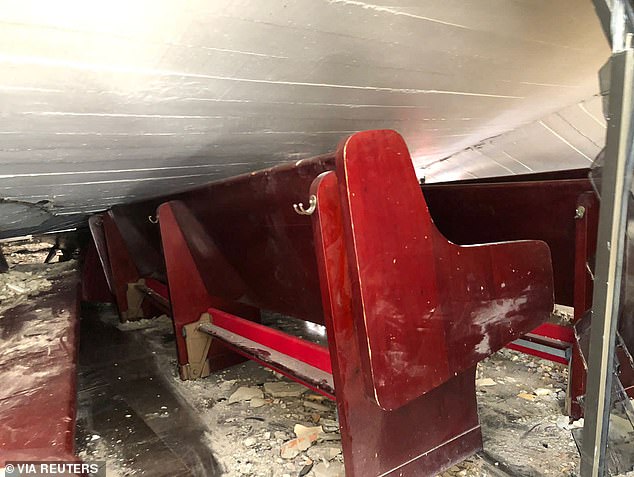
In the quiet town of Faisalabad, Pakistan, a Friday that promised communal worship turned into a day of unimaginable grief. The collapse of a mosque’s roof during prayers claimed the lives of 10 individuals. This heartbreaking event has left the community in mourning and raised questions about infrastructure and faith.
The mosque, a cornerstone of the local community for decades, had seen generations come and go. Its walls bore the stories of countless prayers and celebrations. Yet, as fate would have it, it became a scene of devastation when parts of its roof caved in during Friday noon prayers—a time when the faithful gather to seek divine connection.
Among those who lost their lives were three children whose future was cut short. Their absence leaves a void that words cannot fill, a loss that transcends generations. The survivors, grappling with their own injuries and the suddenness of the tragedy, recounted moments of panic as they scrambled to safety, their minds racing with fear for their loved ones.
The structural integrity of the mosque had been a growing concern. Locals had long expressed worries about its age and lack of maintenance, but these concerns often fell on deaf ears. The government’s response has been slow, raising questions about accountability and the prioritization of public safety.
In the aftermath, faith remains a double-edged sword for the community. While some find solace in their belief, others are left questioning their religious practices. Yet, resilience prevails as makeshift memorials sprout, and efforts to rebuild begin, driven by an unyielding spirit.
This incident is not isolated; it mirrors broader issues of infrastructure neglect seen globally. From developing nations to industrialized countries, such tragedies highlight the systemic inequalities that leave marginalized communities vulnerable. The need for equitable policies in urban planning becomes starkly apparent.
As Faisalabad looks toward reconstruction and calls for justice grow louder, there’s hope. The community is mobilizing resources, rebuilding not just structures but also their collective resolve. In this darkest hour, the light of resilience shines brightest, a testament to the enduring strength of human spirit and the call for a more just future.
About the Author:
Aisha Ali is Cultural Correspondent at our publication. Aisha is an award-winning journalist with a focus on cultural narratives and social justice. Her work explores how local traditions intersect with global dynamics.
 Aisha is an award-winning journalist with a focus on cultural narratives and social justice. Her work explores how local traditions intersect with global dynamics.
 A tech enthusiast and data journalism pioneer, Carlos uses innovative storytelling techniques to uncover trends in global technology and its societal impacts.
 With over 15 years of experience in global journalism, Emily has led award-winning investigative teams and set the editorial direction for numerous publications. Her expertise lies in fostering impactful storytelling that connects diverse communities.
 Fatima is a rising star in investigative journalism, with a focus on uncovering stories that affect marginalized communities. Her work spans South Asia and beyond.
 Hina is a multimedia journalist with a focus on migration and displacement. Her work uses visual storytelling to highlight the human side of global movements.
 Luis brings a unique perspective to global health and science reporting, blending scientific expertise with journalistic storytelling.