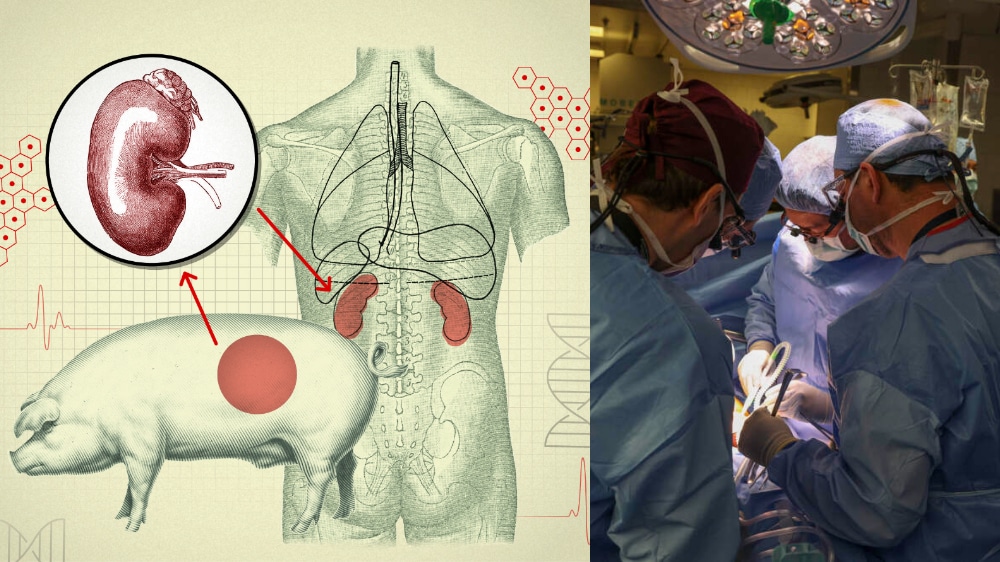
In a world where organ shortages continue to plague millions, science has taken a monumental step forward. Earlier this year, medical history was made when surgeons in the United States successfully transplanted a pig kidney into a human patient. The procedure marked the first time such a transplant had been attempted without the body rejecting the organ immediately—a breakthrough that could revolutionize healthcare for those awaiting life-saving organs.
This achievement is not just a scientific milestone; it’s a beacon of hope for millions of people worldwide, particularly in regions like the Middle East and North Africa where access to organ transplants remains limited by cultural, logistical, and financial barriers. The potential implications for global health are profound, offering a new pathway for individuals who have long faced insurmountable odds in their search for viable organs.
A Glimmer of Hope in the Fight Against Organ Shortages
The patient, whose identity was not revealed, had been living with terminal kidney disease and was deemed ineligible for traditional transplant options. But after receiving the pig kidney in an experimental procedure, the organ functioned as expected, raising hopes that xenotransplantation—a process where animal organs are used to treat human patients—could become a viable solution.
This breakthrough comes after decades of research into xenotransplantation, which has faced significant hurdles, including immune system rejection and ethical concerns. However, advancements in genetic modification and immunosuppressive therapies have brought scientists closer to making this medical frontier a reality.
A Lifeline for Marginalized Communities
In the Middle East and North Africa, organ donation rates are often lower than in other parts of the world due to cultural taboos, lack of awareness, and underdeveloped healthcare systems. Countries like Egypt, Iran, and Saudi Arabia have made strides in improving organ transplantation, but many patients still face long waiting lists and limited access to treatment.
The success of the pig-to-human kidney transplant offers a potential lifeline for these communities. If xenotransplantation becomes widely available, it could alleviate the pressure on donor organs and provide an alternative for individuals who have been unable to find matches through traditional means.
Ethical Considerations in a New Frontier
While the medical breakthrough is undeniably exciting, it raises important ethical questions. Critics argue that relying on animal organs could lead to exploitation of animals or reinforce inequalities if access to such treatments remains limited to wealthier populations. Ensuring that xenotransplantation is equitable and ethically sound will be crucial as this technology progresses.
Additionally, the process of genetically modifying pigs to make their organs compatible with human bodies must be carefully regulated to avoid unintended consequences for animal welfare and environmental sustainability.
A Glimpse Into a Healthier Future
The first successful pig-kidney transplant is more than just a medical marvel—it’s a testament to humanity’s ability to innovate in the face of profound challenges. For patients like the one who received the organ, it represents a second chance at life. For millions more, it offers hope that science can bridge gaps where traditional medicine has fallen short.
As we move forward into this new era of healthcare, it will be essential to balance innovation with compassion, ensuring that no one is left behind in the race for better health outcomes. The pig-kidney transplant may just be the beginning of a new chapter in medical history—one where hope and progress go hand in hand.
About the Author:
Mehdi Hassan is Foreign Correspondent (Middle East) at our publication. A seasoned foreign correspondent with a focus on Middle Eastern affairs, Mehdi brings deep insight into conflict zones and political transitions. His work bridges local narratives with global perspectives.
 Aisha is an award-winning journalist with a focus on cultural narratives and social justice. Her work explores how local traditions intersect with global dynamics.
 A tech enthusiast and data journalism pioneer, Carlos uses innovative storytelling techniques to uncover trends in global technology and its societal impacts.
 With over 15 years of experience in global journalism, Emily has led award-winning investigative teams and set the editorial direction for numerous publications. Her expertise lies in fostering impactful storytelling that connects diverse communities.
 Fatima is a rising star in investigative journalism, with a focus on uncovering stories that affect marginalized communities. Her work spans South Asia and beyond.
 Hina is a multimedia journalist with a focus on migration and displacement. Her work uses visual storytelling to highlight the human side of global movements.
 Luis brings a unique perspective to global health and science reporting, blending scientific expertise with journalistic storytelling.