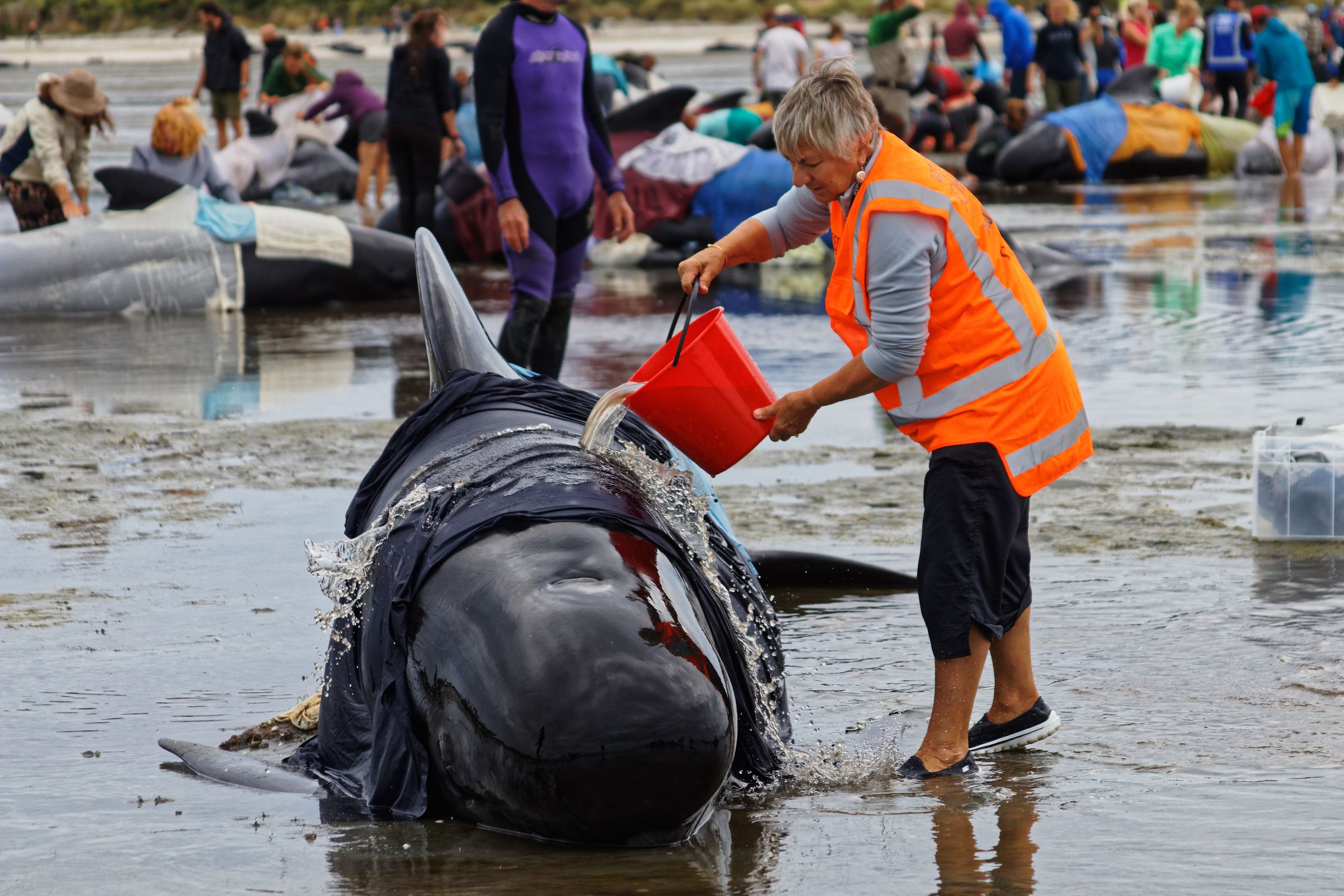
In the quaint coastal town of Kaikōura, New Zealand, nature’s resilience and human compassion converged in an extraordinary display of unity. Earlier this week, over 30 whales found themselves stranded on the shores of this picturesque location, a stark reminder of the delicate balance between marine life and human activity.
The Rescue Effort
When news of the stranding broke, the local community sprang into action. Fishermen, environmentalists, and volunteers from nearby towns joined forces to launch an unprecedented rescue mission. The scene was one of chaos turned into organized effort, as boats were readied, and teams formed to navigate the challenging terrain.
The whales, a mix of species including sperm and pilot whales, had beached themselves in shallow waters. Their survival depended on quick action. Locals shared knowledge about whale behavior, while experts provided scientific insights. The combination of indigenous wisdom and modern techniques proved pivotal in their rescue.
Challenges Overcome
Rescuers faced formidable obstacles. Stormy weather hampered efforts, making the seas unpredictable. The sheer number of whales tested the resolve of even the most seasoned volunteers. Yet, through persistence and innovation, they managed to free each whale, carefully guiding them back into deeper waters where they could safely swim.
Role of Local Communities
Central to this success was the Māori community, whose deep connection to the ocean provided invaluable insights. Their traditional knowledge on navigating tides and understanding marine life complemented the technical expertise brought in by outsiders. This collaboration underscored the importance of integrating indigenous wisdom with contemporary methods.
Broader Implications
The rescue operation in Kaikōura serves as a beacon of hope for global environmental stewardship. It highlights how local communities can rally together to address pressing ecological issues. The incident also underscores the urgent need for sustainable practices, especially as human activities continue to impact marine ecosystems.
Reflection on Collective Action
In a world often divided by differences, the collective effort in Kaikōura stands as a testament to what can be achieved when people unite behind a common cause. It reminds us that even in the face of environmental challenges, hope and action can lead to remarkable outcomes.
As the whales swam free, they carried with them not just survival, but a message of resilience and collective courage. The world watched as a community demonstrated that through unity and dedication, we can overcome even the most daunting challenges, leaving behind a legacy of hope for future generations.
About the Author:
Fatima Khan is Investigative Reporter at our publication. Fatima is a rising star in investigative journalism, with a focus on uncovering stories that affect marginalized communities. Her work spans South Asia and beyond.
 Aisha is an award-winning journalist with a focus on cultural narratives and social justice. Her work explores how local traditions intersect with global dynamics.
 A tech enthusiast and data journalism pioneer, Carlos uses innovative storytelling techniques to uncover trends in global technology and its societal impacts.
 With over 15 years of experience in global journalism, Emily has led award-winning investigative teams and set the editorial direction for numerous publications. Her expertise lies in fostering impactful storytelling that connects diverse communities.
 Fatima is a rising star in investigative journalism, with a focus on uncovering stories that affect marginalized communities. Her work spans South Asia and beyond.
 Hina is a multimedia journalist with a focus on migration and displacement. Her work uses visual storytelling to highlight the human side of global movements.
 Luis brings a unique perspective to global health and science reporting, blending scientific expertise with journalistic storytelling.