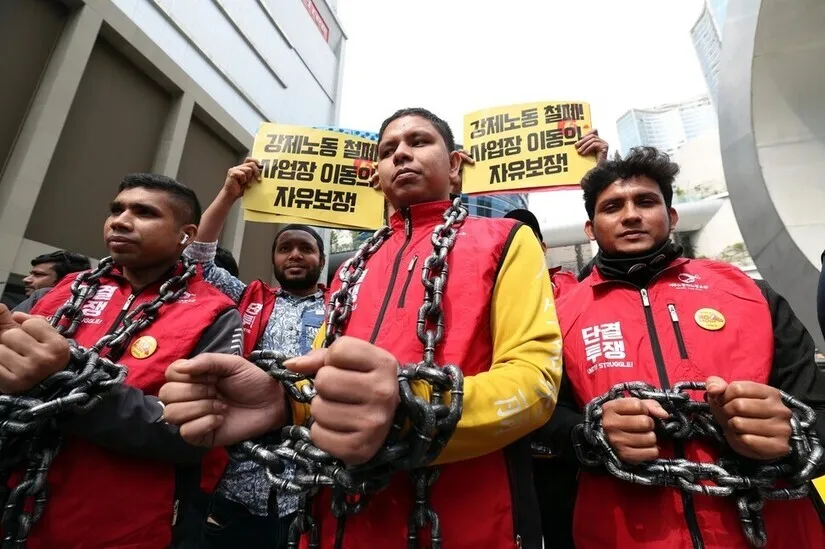
In a quiet corner of South Korea’s bustling port city of Busan, a group of workers once labored under the blazing sun, assembling components for ships that would traverse the globe. These were not ordinary workers; they were part of a movement—a coalition of laborers fighting for justice in an industry that had long overlooked their rights. Their story began like many others: long hours, low wages, and little recourse against systemic exploitation. But it ended differently. After months of advocacy, these workers, detained by US immigration authorities under controversial visa policies, were freed.
The detained workers’ journey from the assembly lines of South Korea to the detention centers of the United States is a tale of resilience, solidarity, and the struggle for dignity in an age of global inequality. It’s a story that intersects with broader labor rights movements and the growing demand for sustainable and just economic systems.
The Detained Workers’ Story
The workers were part of a union organizing campaign in South Korea’s shipbuilding industry, one of the country’s most vital sectors. Their efforts to secure better wages, safer working conditions, and recognition for their contributions were met with resistance from employers. When the company faced financial trouble, it sought to cut costs by laying off thousands. The workers stood their ground, demanding fair treatment.
But their fight took an unexpected turn when they were recruited by a US-based shipping firm. Hoping for better opportunities, they traveled to America, only to find themselves ensnared in a complex web of legal and immigration challenges. The company sponsoring their visas collapsed, leaving them without jobs or financial support. Detained under the Immigration and Nationality Act, they faced deportation, separated from their families and forced to navigate a system that seemed designed to exploit their desperation.
The case gained attention when activists and labor advocates connected it to broader issues of migrant workers’ rights in the global economy. The detained workers became symbols of the systemic inequalities that persist even as the world grapples with climate change, technological disruption, and economic instability.
The Legal Battle Behind the Scenes
The legal battle to free the workers was waged by a coalition of human rights organizations, labor unions, and immigration lawyers. They argued that the detentions violated international labor standards and US immigration laws, which are supposed to protect vulnerable workers. Advocates highlighted the role of corporate greed in creating these conditions, pointing out how the collapse of the sponsoring company had left the workers stranded.
The case also exposed flaws in the H-2 visa program, a temporary work permit often used by employers to exploit migrant labor. Critics argue that the program fails to provide adequate protections for workers, leaving them vulnerable to exploitation and unable to seek justice when their employers fail to pay or provide safe working conditions.
In courtrooms and public forums, activists made the case that freeing these workers was not just about legal justice but about upholding human dignity in an increasingly globalized world. They emphasized the need for stronger labor protections and immigration policies that prioritize workers’ rights over corporate interests.
A Global Echo of Solidarity
The detained workers’ ordeal resonated far beyond South Korea and the United States. It sparked solidarity among migrant workers worldwide, from dockworkers in Latin America to factory employees in Southeast Asia. Their struggle became a rallying cry for those fighting against exploitation in industries tied to global supply chains.
Environmental advocates also found common ground with the workers’ cause. They argued that sustainable development must include fair labor practices. After all, the ships these workers built are part of the global trade network that drives climate change. Addressing inequality is not just a matter of justice—it’s essential for creating a more equitable and environmentally sustainable future.
The case also highlighted the role of technology in modern labor exploitation. Automation and digital platforms have transformed industries, often displacing workers and leaving them with fewer protections. Advocates called for policies that ensure technological progress benefits workers rather than undermines their livelihoods.
The Road Ahead
With the workers’ release, their immediate struggle may be over, but the challenges they faced remain. Advocacy groups are pushing for systemic changes to prevent similar injustices in the future. They’re calling for stronger labor rights protections, reforms to immigration policies, and greater corporate accountability.
The case also underscores the need for cross-border collaboration between activists, policymakers, and international bodies like the United Nations. Only through global solidarity can we address the root causes of exploitation and create a world where every worker can thrive.
As the workers return home, they carry with them not just their freedom but a message of hope. Their story is a reminder that even in the face of overwhelming odds, collective action and unwavering determination can break the chains of injustice. It’s a testament to the power of solidarity—a force that transcends borders, industries, and even time itself.
About the Author:
Priya Patel is Environment Reporter at our publication. Specializing in environmental journalism, Priya has reported from the frontlines of climate change impacts around the world. Her work highlights the intersection of ecology and human communities.
 Aisha is an award-winning journalist with a focus on cultural narratives and social justice. Her work explores how local traditions intersect with global dynamics.
 A tech enthusiast and data journalism pioneer, Carlos uses innovative storytelling techniques to uncover trends in global technology and its societal impacts.
 With over 15 years of experience in global journalism, Emily has led award-winning investigative teams and set the editorial direction for numerous publications. Her expertise lies in fostering impactful storytelling that connects diverse communities.
 Fatima is a rising star in investigative journalism, with a focus on uncovering stories that affect marginalized communities. Her work spans South Asia and beyond.
 Hina is a multimedia journalist with a focus on migration and displacement. Her work uses visual storytelling to highlight the human side of global movements.
 Luis brings a unique perspective to global health and science reporting, blending scientific expertise with journalistic storytelling.