DR Congo: Ebola Crisis Kills 100 as Six Americans Face Exposure
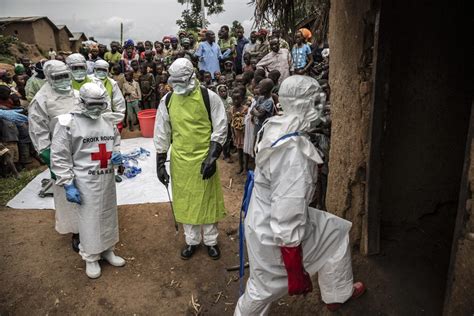
In the dense jungles of DR Congo, a shadow has fallen over the people of Mbandaka. The Ebola virus, a relentless and deadly pathogen, has claimed yet another hundred lives, leaving behind grieving families and a community teetering on the edge of collapse. But this crisis is not just a local tragedy—it has reached far beyond the borders of Central Africa, touching a group of six Americans who are now at risk of contracting the virus.
The outbreak began in late February, when the first cases emerged in rural areas near the Ebola River. Health workers quickly identified the cases, but the disease spread rapidly, exploiting weak healthcare infrastructure and deep-seated mistrust in government institutions. By mid-March, the death toll had reached 100, with infected individuals pouring into overcrowded hospitals and makeshift clinics.
Amidst this chaos, a group of American missionaries working in the region found themselves unexpectedly caught up in the unfolding disaster. The six individuals—three doctors, two nurses, and a logistics coordinator—had been supporting local health initiatives for years. Their presence was not tied to any controversial foreign intervention; they were there out of a commitment to service and solidarity with the Congolese people.
But when the virus broke out, their proximity to infected communities put them at risk. A minor scratch, an accidental exposure, or even a moment of human contact could have deadly consequences. The news that six Americans had been potentially exposed sent shockwaves through global health organizations, highlighting the interconnectedness of our world—and the dangers of complacency in the face of infectious diseases.
A Global Health Crisis in Microcosm
The DR Congo Ebola outbreak is not new. The country has faced multiple Ebola epidemics over the past decade, with 2018-2019 seeing one of the worst outbreaks in its history, which claimed more than 2,200 lives. Yet each time, the world seems to forget until the next crisis erupts.
This time is different. The global response has been slower, perhaps because the world’s attention is fixed on other crises—like the ongoing war in Ukraine or the economic turmoil sparked by inflation. But for those living in Mbandaka and surrounding regions, this outbreak is no less urgent than any other.
The death toll of 100 may seem small compared to previous outbreaks, but each life lost is a tragedy compounded by the fact that many of these deaths could have been prevented with better access to healthcare, vaccines, and education. The slow rollout of vaccines in DR Congo has left the country vulnerable, despite the availability of effective treatments.
Meanwhile, the six Americans facing potential exposure have become symbols of this intersection between global health and international relations. Their situation raises questions about the ethics of vaccine distribution and the responsibilities of wealthier nations to support healthcare systems in low-income countries.
The Politics of Disease
The Ebola crisis in DR Congo is not just a health issue—it’s a political one. Decades of resource exploitation, colonial legacies, and underinvestment in public health have left the country ill-equipped to handle such outbreaks on its own. While international aid has been slow to arrive, Western companies continue to profit from DR Congo’s mineral wealth, particularly its cobalt reserves, which are critical for electric car batteries.
This disparity is not lost on local communities. Trust between citizens and their government is already fragile due to corruption and decades of neglect. When foreign missionaries or health workers arrive, they often face suspicion—whether it’s justified or not.
The case of the six Americans adds another layer of complexity. Are they heroes risking their lives for others? Or are they representatives of a system that has historically exploited DR Congo’s resources and people?
These questions are difficult to answer, but they must be asked if we’re to move toward a more equitable global health system.
Looking Ahead
The good news is that the six Americans have since undergone quarantine and testing. None have shown signs of infection so far, though they will remain under observation for several weeks.
But their exposure—and the attention it has garnered—should serve as a wake-up call. If even a group of well-intentioned outsiders can be caught in the crossfire of an Ebola outbreak, what does that say about the people who live there every day?
The solution lies not in saving Westerners but in ensuring that everyone has access to the care and resources they need to survive. That means investing in local healthcare systems, promoting transparency in international aid, and addressing the root causes of health crises like poverty and inequality.
As DR Congo continues to battle Ebola, let’s hope this time is different. Let’s hope the world doesn’t forget until the next outbreak hits. And let’s hope that when we think about global health, we remember that it starts—and ends—with those who call Mbandaka home.
About the Author:
Emily Carter is Chief Editor at our publication. With over 15 years of experience in global journalism, Emily has led award-winning investigative teams and set the editorial direction for numerous publications. Her expertise lies in fostering impactful storytelling that connects diverse communities.
 Aisha is an award-winning journalist with a focus on cultural narratives and social justice. Her work explores how local traditions intersect with global dynamics.
 A tech enthusiast and data journalism pioneer, Carlos uses innovative storytelling techniques to uncover trends in global technology and its societal impacts.
 With over 15 years of experience in global journalism, Emily has led award-winning investigative teams and set the editorial direction for numerous publications. Her expertise lies in fostering impactful storytelling that connects diverse communities.
 Fatima is a rising star in investigative journalism, with a focus on uncovering stories that affect marginalized communities. Her work spans South Asia and beyond.
 Hina is a multimedia journalist with a focus on migration and displacement. Her work uses visual storytelling to highlight the human side of global movements.
 Luis brings a unique perspective to global health and science reporting, blending scientific expertise with journalistic storytelling.